


By Nathaniel Udoh
Inside Tech Derby’s Model for Academic–Industry Collaboration and Startup Acceleration
Tech Derby is quietly shaping one of the most promising UK–Africa innovation bridges-and its strategy offers a fresh blueprint for how academic institutions can function as neutral, catalytic spaces for startup growth, ecosystem partnerships, and technology talent development.
The community-led initiative, hosted within the University of Derby’s Game Changer Labs, is connecting African founders, technologists, and UK students in ways that go beyond the typical conference handshake. With a focus on experimentation, cross-cultural collaboration, and applied learning, Tech Derby is positioning itself as an innovation testbed where Africa’s emerging talent pool meets the UK’s growing appetite for diverse digital capabilities.
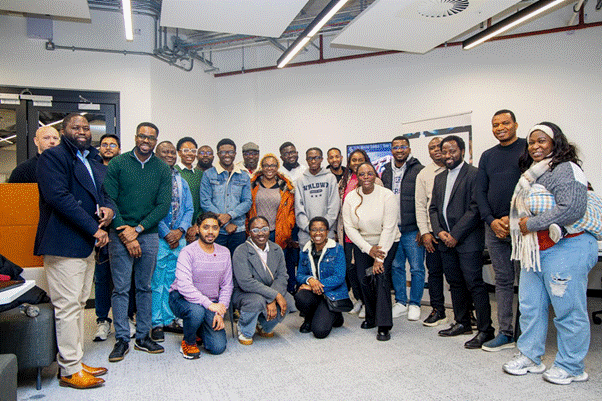
In a statement on Tuesday, the organisation explained that the programme positions universities as convening platforms—where industry players, policymakers, technologists, students, and grassroots innovators can co-create solutions under one shared innovation roof. Its participants cut across Nigeria, the broader African continent, and the global diaspora.
Professor of Economics Mark Gilman, of the University’s Regional Economic Observatory, brought academic clarity to the conversations, highlighting how SME performance in Africa can be accelerated through mindset, strategy, and digital transformation—a framework he called the “Transformation Triangle.” He pledged to contribute tools that will “accelerate founder success.”
For Head of Enterprise, Samantha Deakin, Game Changer Labs functions as a living innovation ecosystem—a space where “students and founders can test ideas in real time,” blurring the lines between classroom theory and startup execution. Enterprise Manager Oliver Stonier added that the university has now created structured pathways for students and graduates to engage more directly with Tech Derby’s programmes.
The showcase delivered a mix of ingenuity and practical problem-solving. Tope Akande, founder of BucksTrybe, demonstrated a fintech solution that helps “credit-invisible” Africans build credible credit histories. Oluwatobi Akinlade of McAnderson presented Mastery Quest, a gamified maths-learning platform bridging academic gaps. Blockchain and Web3 specialist Gbenga Ajiboye underscored Africa’s accelerated adoption of decentralised systems to solve trust and verification challenges—an area where the continent is outpacing many Western markets. Behind the scenes, the initiative is held together by Community & Innovation Lead Joseph Origbo and Community & Partnerships Coordinator Omolara Oladipupo, who drive collaboration outcomes and ensure participants stay connected to opportunities.
Tech Derby’s founder, Akindayo Akindolani, whose work spans Nigeria and the UK, captured the programme’s essence in a statement:
“We’re creating a space where an African founder in the UK can test ideas, a student can find a mentor, and a professor’s research can actually reach businesses. Tech Derby is about community first. From there, we connect Derby to the wider African tech story.”
What Makes Tech Derby a Powerful Model?
Universities as Innovation Brands: Globally, winning innovation ecosystems-from MIT to Stanford to University of Cape Town-succeed because universities function not just as academic spaces but as brand-neutral innovation hubs. Tech Derby follows this model, positioning Derby as a convening brand bridging markets, talent pools, and technologies.
Cross-Border Collaboration as a Talent Strategy: Africa’s digital population is booming. The UK’s demand for tech talent is rising. Tech Derby taps into this intersection, becoming a brand ambassador for UK–Africa tech synergies that accelerate employability, digital literacy, and startup velocity.
Community as the Core Brand Asset: By emphasising community-first innovation, Tech Derby builds a sticky ecosystem rather than one-off programme events-what brand theorists call experience networks, not touchpoints.
Industry-Academia Reintegration: The programme mirrors global best-in-class models such as: Harvard i-Lab (student-driven innovation). Oxford Foundry (industry-partnered entrepreneurship). African Leadership University School of Entrepreneurship (applied learning). Tech Derby localises this model for African and UK realities.
Conclusion: A New Brand of Tech Partnership is Emerging
With its blend of collaboration, experimentation, and community-driven innovation, Tech Derby is fast becoming a case study in how strategic cross-border partnerships can shape the future of African tech talent, enterprise development, and academic relevance.
For African founders navigating global markets – and UK institutions seeking diversity in innovation pipelines – Tech Derby offers a blueprint worth watching.