

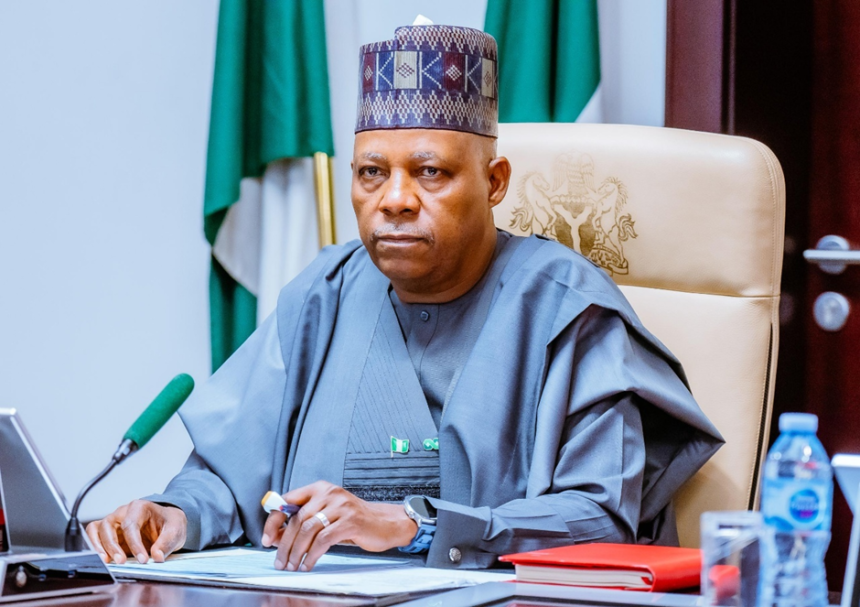
Photo: Vice President Kashim Shettima
Nigeria’s textile imports rose to N814.27bn in the first nine months of 2025, despite repeated claims by the Federal Government that it is reviving the sector. Stakeholders noted that the rising importation signalled a weaker local industry and a deepening dependence on foreign fabrics.
Findings from the National Bureau of Statistics’ trade data showed that the country imported textile and textile articles worth N228.83bn in the first quarter of 2025, N337.12bn in the second quarter, and N248.32bn in the third quarter, bringing the January–September total to N814.27bn.
The figure represents a 47.43 per cent increase compared to the N552.31bn recorded in the corresponding period of 2024. Industry operators told The Punch that the textile industry keeps declining amid repeated government promises, due to policy failure, weak execution of credit initiatives, and pervasive corruption.
These operators blamed the import surge on poor implementation of government interventions, lack of access to affordable finance through the Bank of Industry, abandonment of promised institutional reforms, and structural bottlenecks such as weak cotton farming, insecurity, and the inability to scale locally produced polyester.
Director-General of the Nigerian Textile Manufacturers Association, Hamma Kwajaffa, stated that the rising import bill showed that government policies on textile revival had remained largely rhetorical.
Kwajaffa said, “You see, this increased import is why it is now important to levy a textile tax. So that tax is supposed to be ploughed into the production of the textiles. But the government takes that money as part of their money, as if these funds were meant for the government, and not for improvement or to make the local textile industry competitive.”
He explained that when the ban on textile imports was lifted, the government introduced a 10 per cent levy with the understanding that the proceeds would be reinvested in the industry to enhance competitiveness and reduce import dependence.
“The essence is that when the ban on textiles was lifted, they knew the Nigerian with their penchant for foreign goods, and therefore they want to be sure that 10 per cent of that fund is ploughed back into textiles so that they can be competitive,” the textile manufacturers’ chief said. “But that money, once it comes in, the government feels it is their own, and they don’t want to give it back to the private sector to work on.”
Kwajaffa faulted the failure to create a dedicated textile development fund domiciled with the BOI, noting that the sugar industry had benefitted from a similar levy because it had a functioning council and political backing.
He stated, “Instead of collecting loans they can use, they can have a fund for that levy, a textile development fund somewhere kept at the Bank of Industry. But that one has not been discussed [by government officials], and it’s not working anywhere. What they [the government] are working on is the sugar council levy.”
Kwajaffa revealed that nothing has been ploughed back into the textile industry from the levy since its inception. He lamented the practice of selective government attention, stating, “So because nobody is there in the textile industry that can speak to the government or to go and then be acceptable, nothing is being done with that fund. Nothing at all has been ploughed since inception.”
Kwajaffa also criticised what he described as policy incoherence within the government, saying conflicting positions among top officials had stalled action. “Vice President Kashim Shettima is speaking on a different level; the Minister of State for Industry, Sen. John Enoh, is speaking differently. That’s how things don’t work.”
The Federal Government has repeatedly announced plans to revive the sector. On August 6, 2024, Vice-President Kashim Shettima urged stakeholders to produce a roadmap for revitalising the cotton and textile industry, citing collaboration with the International Cotton Advisory Committee.
In April, the Federal Ministry of Industry, Trade and Investment said it aimed to “localise up to $4bn in spending on textile imports,” while Minister of State for Industry, Enoh, announced plans to promote local garments across ministries and work with the BOI to provide finance and machinery to operators.
Although the ministry and the BOI toured textile facilities in Kaduna State to kick-start the initiative, stakeholders said the reforms had dragged on while imports continued to surge.
Kwajaffa warned that repeated workshops and announcements without execution had yielded no tangible outcome. “We’re tired of all these workshops that the communiqués are just dust and kept somewhere in the drawer of some civil servant,” he said.
He called for a clear institutional framework, urging the government to domicile the textile levy with the BOI and deploy it transparently to support firms grappling with high energy costs and weak infrastructure.
“If imports continue rising and then there’s nothing to be done with competition so that they can reduce imports, it will continue to be like that,” he stressed. “The government has clearly given out the 10 per cent textile levy to the textile fund. But to achieve it, to implement it, is a problem.”
He further alleged that corruption was frustrating credit and grant programmes meant to support manufacturers. “Mostly the problem with the grant is that they also want to get their own,” he said. “If they go and tell the companies what their share is, that’s the problem. Once they don’t have a share, they kill the programme.”
Describing the impact of corruption as systemic, he added, “It’s all a matter of kickback, kickfront. And because of that, things will stagnate. Corruption is killing everything. Nothing is moving at all for the interest of the generality of the Nigerian populace.”
Kwajaffa said insecurity and weak agricultural support had also undermined the cotton value chain, stressing that cotton farming in Nigeria remained largely smallholder-based and poorly mechanised.
“Cotton is a scientific product,” he said. “The farmer has to be tutored. Extension officers cannot even go to the field because of insecurity, and the government finds it difficult to fund them.”
He added that local manufacturers also struggled to access cheap polyester despite Nigeria being a crude oil producer. “Most local textile players are unable to get their hands on cheap polyester despite our crude oil,” he said.
Meanwhile, the Director-General of the Manufacturers Association of Nigeria, Segun Ajayi-Kadir, earlier warned that rising textile imports had continued to undermine local production.
“The heavy influx of finished textile materials discourages domestic production,” Ajayi-Kadir said. “These products are virtually dumped, consciously and intentionally, to overrun the domestic market. Local firms cannot compete due to the harsh operating environment, so they fizzle out.”
He recalled that Kaduna State once hosted at least six textile companies under MAN’s coverage, but said “now there’s zero,” adding that even backward integration into cotton farming had suffered as producers preferred to export due to poor domestic competitiveness.
Source: The Punch