

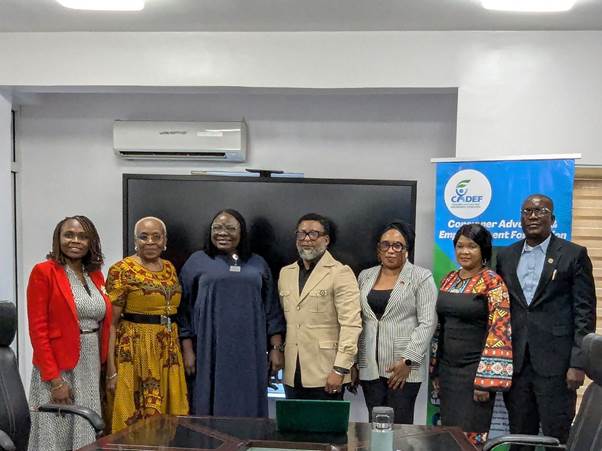
Photo shows a cross section of Executives and consumer advocates at the Public Eye press conference held in Lagos recently.
Nestlé has come under scrutiny after Swiss NGO Public Eye alleged in its report that the company sells infant cereals in Africa with higher sugar content than in developed markets, prompting debate over nutrition standards for babies on the continent.
In the report discussed earlier this week at a press conference in Lagos by Nigeria’s Consumer Advocacy and Empowerment Foundation, the group said laboratory tests of nearly 100 products from Nestlé’s Cerelac range found that more than 90 per cent contained added sugar, a practice it said does not occur in Europe.
Nestlé rejected the claims, telling Sunday PUNCH in an email that it “does not have double standards when it comes to early childhood nutrition.” The baby food giant said it had shared its position with Public Eye last year, asserting that the reported sugar levels reflected naturally occurring sugars from ingredients like milk and fruit, rather than refined added sugar.
The company also noted that all its infant cereals comply with Codex Alimentarius thresholds, applied uniformly across all markets, and highlighted ongoing efforts to expand no-added-sugar variants in Africa, including products undergoing regulatory approval in Nigeria.
“No-added-sugar variants are already available in Ghana, and we are expanding to other countries in Central and West Africa. In Nigeria, our infant cereals without added sugars are undergoing regulatory approvals,” the email stated.
At the press conference, the Director of Consumer Advocacy and Empowerment Foundation, Professor Chiso Ndukwe-Okafor, described the findings as a deliberate corporate choice exposing African babies to sugar levels unacceptable in European markets.
She warned that early exposure to added sugar could contribute to obesity, diabetes, dental decay, and lifelong dependence on sweetened foods.
“Consumers are clear: we want zero added sugar in baby foods. There is no justification for added sugar when natural sugars are already present in the ingredients,” Ndukwe-Okafor told reporters.
The executive also called on Nigerians to define their own nutrition standards rather than rely on outdated Codex benchmarks and revealed that CADEF and other African groups are writing to Nestlé’s global president to demand equal quality for African children.
Public Eye’s Food Systems Researcher, Laurent Gaberell, said the investigation revealed “dangerously high and hidden sugar levels” and criticised the lack of clear labelling, noting that consumers cannot distinguish added sugar from natural sugar without laboratory testing.
He also urged regulators to revise Codex standards, which permit up to 30 per cent added sugar in infant cereals, calling them outdated and scientifically unsupported.
The report prompted responses from Nigerian authorities. General Manager of the Lagos State Consumer Protection Agency, Afolabi Solebo, described the revelations as a serious public health concern and pledged collaboration with the Federal Competition and Consumer Protection Commission and other stakeholders to protect children.
In response to concerns, NAFDAC Director Dr Ifeoma Okafor stated that the agency carefully evaluates all infant food products before approval.
She noted that both the Codex Alimentarius and Nigeria’s Industrial Standards allow the inclusion of ingredients like sucrose, fructose, glucose syrup, and honey in infant cereals, provided that total added carbohydrates do not exceed 7.5 grams per 100 kilocalories and added sucrose stays below 0.9 grams per kilocalorie.
“Adherence to Codex standards determines compliance. Variations in product formulation across countries do not automatically constitute a violation. Being a developing nation does not mean Nigeria compromises on nutritional quality,” she added.