

A new report by PiggyVest has exposed a deepening contradiction at the heart of Nigeria’s economy: improving macroeconomic indicators are not translating into financial wellbeing for citizens.
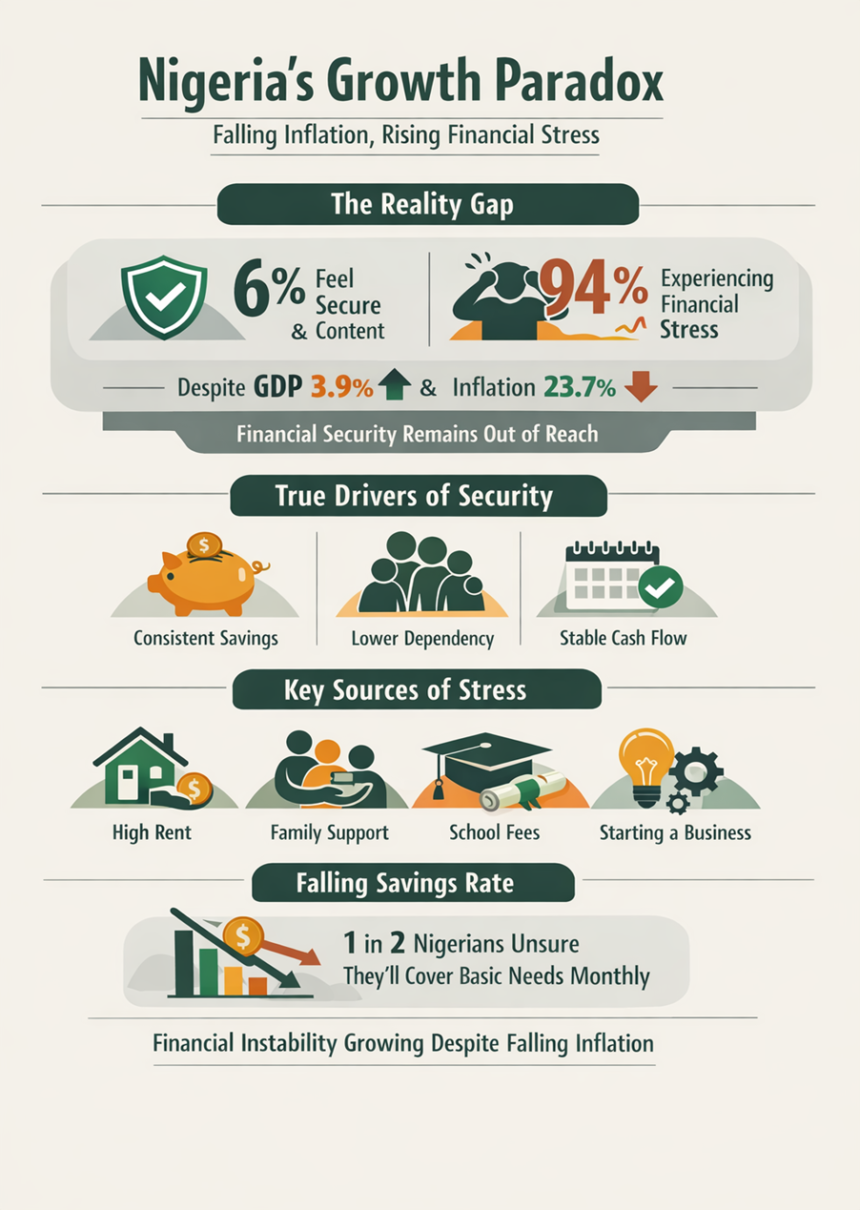
The PiggyVest Savings Report 2025, based on responses from over 26,000 Nigerians, reveals that while inflation is easing and GDP growth remains positive, 94% of Nigerians still experience financial stress, with only 6% reporting a sense of stability and contentment.
Economic Analysis: The Illusion of Macroeconomic Progress
On paper, Nigeria’s economy appears to be stabilising:
- Inflation moderating to ~23.7%
- GDP growth approaching 3.9%
- Relative currency strengthening
Yet, beneath these indicators lies a more complex reality:
Economic recovery is notyet a lived experience – it is a statistical one.
This disconnect highlights a structural issue:
macroeconomic gains are not cascading into household-level resilience.
The Real Drivers of Financial Security (Hint: It’s Not Income)
One of the report’s most striking insights challenges conventional thinking:
Higher income does not guarantee financial security.
Instead, financial stability is driven by:
- Consistent saving habits (54% of secure individuals save monthly)
- Lower dependency burdens
- Predictable cash flow
Surprisingly, some individuals with no stable monthly income still report financial security – underscoring that behaviour and structure matter more than earnings alone.
Structural Pressures Defining Nigerian Households
For the majority, financial stress is not driven by lifestyle choices – but by systemic obligations:
- Rent and housing costs
- Family and social support (“black tax”)
- School fees
- Capital required to start or sustain a business
These recurring pressures create a cycle where:
Income is consumed immediately
Savings become impossible
Financial buffers never form
A Dangerous Trend: Declining Savings Culture
The report also highlights a worrying shift:
- Monthly savers have declined for three consecutive years
- Over 50% of Nigerians are unsure if their income can cover basic expenses each month
This signals a transition from financial strain to financial instability – a more dangerous long-term condition.
Strategic Implication: Rethinking Economic Success Metrics
The findings raise critical questions for policymakers, financial institutions, and brands:
- Should GDP and inflation remain the primary indicators of success?
- How can financial systems enable predictability and resilience, not just income growth?
- What role can fintechs play in embedding behavioural financial discipline at scale?
What This Means for Brands & the Digital Economy
For brands operating in Nigeria:
- Financial anxiety is now a dominant consumer reality
- Products and messaging must reflect value, stability, and trust
- Fintech and savings platforms have a major opportunity to own the “financial peace of mind” narrative
Bottom Line
Nigeria is not just facing an income problem – it is facing a structural stability crisis.
Until households gain predictable cash flow, reduced obligations, and saving discipline, macroeconomic progress will continue to feel distant