


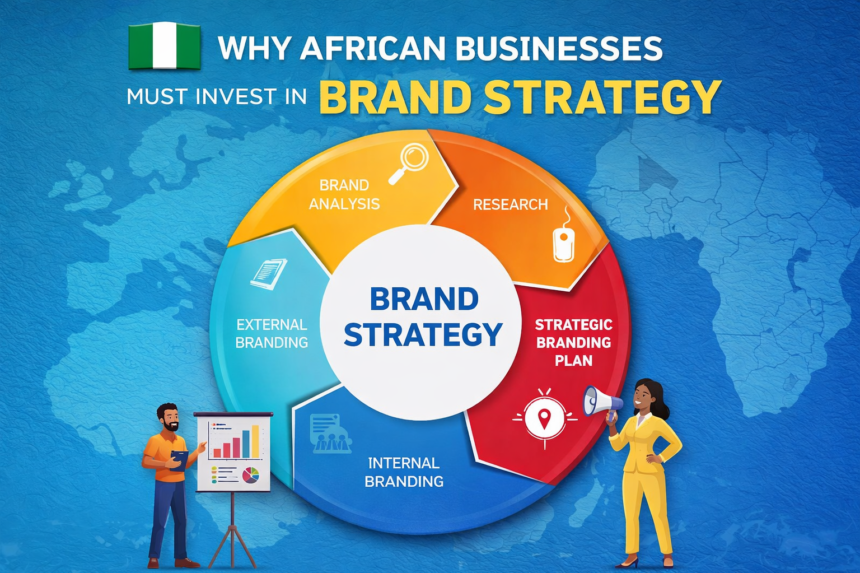
The Silent Growth Lever Most African Businesses Ignore
Across Nigeria, Ghana, Kenya, and the wider African continent, entrepreneurship is no longer the problem. The continent is producing founders, startups, SMEs, and scale-ups at an unprecedented rate. Capital is flowing. Technology adoption is accelerating. Consumer markets are expanding.
Yet one uncomfortable truth remains:
many African businesses struggle to scale, sustain growth, or build long-term value.
The problem is not always product quality. It is not always funding. And it is rarely effort.
The missing link is often brand strategy.
Too many African businesses still treat branding as an afterthought—something to “fix later” with a logo redesign, a social media refresh, or a new campaign. But branding is not decoration. It is not aesthetics. It is not marketing.
Brand strategy is the foundation of business growth.
Without it, businesses compete on price, struggle with customer trust, fail to differentiate, and ultimately stagnate—even in high-demand markets.
This is why African businesses must rethink branding—not as a cost, but as a strategic investment with measurable returns.
The African Context: Why Brand Strategy Matters More Here
Africa is not a single market. It is a complex ecosystem of:
- 54 countries
- Over 2,000 languages
- Diverse cultural, economic, and behavioral patterns
This complexity is not a challenge—it is an opportunity. But only for businesses that understand how to position themselves strategically.
Research shows that companies that prioritize cultural intelligence and localization outperform competitors in emerging markets in trust and customer loyalty.
In Africa, this reality is amplified.
A brand that resonates in Lagos may fail in Nairobi. A message that works in Accra may fall flat in Johannesburg. Consumers are not just buying products—they are buying meaning, identity, and relevance.
This is why brand strategy—not just branding—is critical.
Branding vs Brand Strategy: The Costly Confusion
One of the biggest problems in African business ecosystems is misunderstanding what branding actually means.
Many SMEs believe:
- Branding = logo
- Branding = Instagram aesthetics
- Branding = advertising
But without strategy, these efforts are disconnected.
As observed in Nigerian SME analysis, businesses often invest in visuals but still struggle because they lack clarity on who they serve, what they stand for, and why customers should choose them.
The result?
- Inconsistent messaging
- Weak differentiation
- Low conversion rates
- Rising marketing costs
In simple terms:
They are visible, but not valuable.
Brand strategy answers the deeper questions:
- Who exactly is your customer?
- What unique position do you occupy?
- What emotional and functional value do you deliver?
- Why should anyone trust you?
Without these answers, growth becomes accidental—not repeatable.
1. Brand Strategy Builds Trust in Low-Trust Markets
Trust is currency in African markets.
In many sectors—especially fintech, e-commerce, healthcare, and logistics—customers are cautious. Fraud, poor service delivery, and inconsistent quality have made consumers skeptical.
This is where brand strategy becomes powerful.
A strong brand:
- Signals credibility
- Reduces perceived risk
- Creates familiarity
- Encourages repeat purchase
In Nigeria’s crowded business environment, branding is a key driver of recognition, trust, and loyalty, helping businesses stand out and gain customer confidence.
Case Insight: Flutterwave
Flutterwave didn’t just build payment infrastructure. It built a brand around African innovation, reliability, and global relevance.
Its positioning made it:
- Attractive to global investors
- Trustworthy to African businesses
- Recognizable across multiple markets
This is not accidental. It is brand strategy in action.
2. It Drives Differentiation in Saturated Markets
Walk through any major African city—Lagos, Accra, or Nairobi—and you’ll see the same pattern:
- Multiple businesses offering similar products
- Competing largely on price
- Struggling to stand out
This is not a supply problem. It is a positioning problem.
Without brand strategy:
- Everyone sounds the same
- Everyone looks the same
- Everyone competes on cost
And in price wars, nobody truly wins.
What Brand Strategy Changes
It allows businesses to:
- Own a clear category or niche
- Communicate a unique value proposition
- Attract the right customers—not everyone
Because here’s the truth:
If your brand is not differentiated, your product becomes a commodity.
3. Brand Strategy Increases Profitability (Not Just Visibility)
Many African founders chase visibility:
- More followers
- More ads
- More impressions
But visibility without positioning does not equal revenue.
In fact, it often increases costs.
When brand strategy is weak:
- Customer acquisition becomes expensive
- Conversion rates drop
- Retention suffers
On the other hand, strong brands:
- Convert faster
- Retain longer
- Command higher prices
Research in African B2B markets shows that brand credibility, perceived value, and reputation significantly influence purchasing decisions.
This means:
People don’t just buy the cheapest option.
They buy the most trusted and relevant brand.
4. It Enables Scalability Across African Markets
Scaling in Africa is not straightforward.
Each country comes with:
- Different regulations
- Different cultural expectations
- Different consumer behaviors
Businesses that try to scale without brand strategy often fail because they treat Africa as one homogeneous market.
But successful brands do the opposite.
They build:
- A strong core identity
- Flexible, localized messaging
Example: Jumia
Jumia’s success is not just logistics or technology—it is brand adaptation.
- Local campaigns
- Country-specific messaging
- Contextual relevance
This approach aligns with research showing that localized branding improves engagement, conversion, and loyalty in African markets.
5. Brand Strategy Attracts Investment and Partnerships
Investors don’t just invest in products. They invest in perception, scalability, and market positioning.
A business with:
- Clear positioning
- Strong narrative
- Consistent identity
is easier to understand—and easier to fund.
In contrast, businesses without brand clarity often struggle to:
- Communicate their value
- Stand out in pitch environments
- Build investor confidence
This is why globally, companies like Stripe or Airbnb invested in brand early.
African businesses must do the same.
6. It Turns Businesses into Movements, Not Just Companies
The most powerful brands in the world are not just businesses. They are movements.
They stand for something.
They connect emotionally.
They inspire loyalty beyond transactions.
But many African businesses still communicate only:
- Features
- Prices
- Promotions
What’s missing is story.
According to BrandiQ analysis, many African startups struggle with storytelling, focusing on product features instead of mission-driven narratives that build emotional connection.
Yet Africa has some of the most powerful business stories globally:
- Financial inclusion
- Youth empowerment
- Agricultural transformation
- Digital access
When these stories are told strategically, they create brands that people believe in—not just buy from.
7. Brand Strategy Reduces Marketing Waste
One of the most overlooked benefits of brand strategy is efficiency.
Without strategy:
- Campaigns are inconsistent
- Messaging changes frequently
- Marketing becomes trial and error
This leads to wasted budgets.
With strategy:
- Messaging is clear
- Campaigns are aligned
- Channels are optimized
Every naira, cedi, or shilling works harder.
8. It Strengthens Internal Alignment and Company Culture
Brand strategy is not just external—it is internal.
A clear brand:
- Aligns teams
- Guides decision-making
- Defines company culture
Employees understand:
- What the company stands for
- How to communicate
- What success looks like
This is especially critical for growing African startups where:
- Teams scale quickly
- Structures are evolving
- Culture can easily become fragmented
9. The Cost of Ignoring Brand Strategy
The consequences of ignoring brand strategy are visible across African markets:
- High startup failure rates (with some estimates suggesting up to 70% fail within five years)
- Businesses stuck in price competition
- Weak customer loyalty
- Poor scalability
Many of these failures are not due to lack of innovation—but lack of positioning.
10. The Future: Brand-Led Growth in Africa
Africa’s next generation of winning companies will not just be:
- Product-led
- Tech-driven
- Capital-backed
They will be brand-led.
Because as markets mature:
- Competition increases
- Consumers become more discerning
- Trust becomes harder to earn
And in that environment, brand becomes the ultimate differentiator.
Practical Steps: How African Businesses Can Start
- Define your audience clearly
Stop targeting “everyone.” Specificity drives growth. - Clarify your positioning
What makes you different—and why does it matter? - Build a compelling brand story
Not just what you do, but why you exist. - Invest in consistency
Across messaging, visuals, and experience. - Localize intelligently
Adapt without losing core identity. - Measure brand performance
Track perception, trust, and loyalty—not just sales.
Brand Strategy Is Not Optional
African businesses are operating in one of the most dynamic, complex, and opportunity-rich markets in the world.
But complexity demands clarity.
And clarity comes from strategy.
Brand strategy is not a luxury for large corporations. It is not something to consider “later.” It is the foundation on which sustainable growth is built.
In a continent where:
- Markets are crowded
- Trust is fragile
- Consumers are evolving
The businesses that win will not just be the best—they will be the best understood.
And that begins with brand strategy.