

By BrandiQ Analyst
Energy major TotalEnergies has announced a new hydrocarbon discovery offshore the Republic of the Congo, reinforcing the country’s ambition to scale oil production to 500,000 barrels per day (BPD) and positioning infrastructure-led exploration as a defining model for mature producers.
The discovery, located within the Moho licence, marks a strategic inflection point—not just for Congo’s upstream sector, but for how African energy markets are rethinking efficiency, capital deployment, and resource optimisation.
The Discovery: Unlocking Value Within Existing Assets
The find targets the Moho G structure within the broader Moho complex—already responsible for more than half of Congo’s oil output.
Operated by TotalEnergies (63.5%) in partnership with Société Nationale des Pétroles du Congo (SNPC) and Trident Energy, the well encountered a 160-metre hydrocarbon column in high-quality reservoirs.
Crucially, the discovery sits close to existing infrastructure, enabling:
- Cost-efficient tie-backs to current facilities
- Faster path to commercialisation
- Improved project economics in a capital-constrained environment
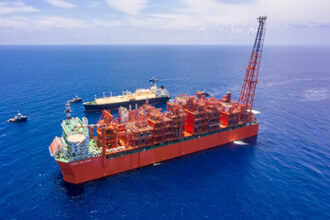
This proximity allows integration with existing FPSO assets, including Alima and Likouf, which currently deliver a combined capacity of 90,000 BPD.
Strategy in Focus: The Rise of Infrastructure-Led Exploration
Unlike frontier exploration, which is capital-intensive and high-risk, Congo’s model emphasises maximising output from proven basins using existing infrastructure.
This approach reflects a broader shift in global energy strategy:
- From Expansion to Optimisation: Extracting more value from established assets
- From CapEx Intensity to Efficiency: Leveraging sunk infrastructure costs
- From Exploration Risk to Execution Certainty: Prioritising near-field discoveries
TotalEnergies’ continued investment – over $500 million committed to the Moho Nord complex in 2025 – underscores confidence in this model.
Policy, Partnerships and Investment Climate
Industry stakeholders, including the African Energy Chamber, have highlighted Congo’s enabling environment as a critical success factor.
Collaboration between government and operators – led by institutions such as SNPC and the Ministry of Hydrocarbons under Bruno Richard Itoua – has created a framework where:
- Policy stability supports long-term investment
- Partnerships de-risk exploration activity
- Local institutions play active roles in value creation
This alignment positions Congo as a competitive destination for upstream investment, even as global capital becomes more selective.
Beyond Oil: LNG Expansion and Energy Diversification
Congo’s energy strategy extends beyond crude production. The launch of the Nguya FLNG unit—led by Eni—in late 2025 marked a significant leap in liquefied natural gas (LNG) capacity.
With combined output now reaching 3 million tonnes per annum (mtpa), Congo has emerged as one of Africa’s top LNG exporters, processing gas from key offshore fields.
This dual-track approach – oil optimisation and gas expansion – signals a holistic energy strategy designed for resilience and global relevance.
Regional Momentum: A Broader Exploration Wave
The Moho discovery is part of a wider surge in Congo’s upstream activity. Operators such as Perenco are advancing new infrastructure projects, including the Kombi 2 platform, aimed at unlocking additional reserves and improving field efficiency.
Together, these developments point to a coordinated national effort to:
- Increase production capacity
- Enhance operational efficiency
- Extend the lifecycle of mature assets
BrandiQ Insight
TotalEnergies’ latest discovery is more than a technical success – it is a validation of a strategic philosophy.
In a world where capital discipline is tightening and energy transition pressures are mounting; Congo’s model offers a compelling blueprint:
Growth in the energy sector will increasingly come not from where you explore, but from how intelligently you exploit what you already have.
For African energy economies – and resource-rich nations like Nigeria – the lesson is clear:
infrastructure, policy coherence, and strategic partnerships are the new drivers of upstream competitiveness.