

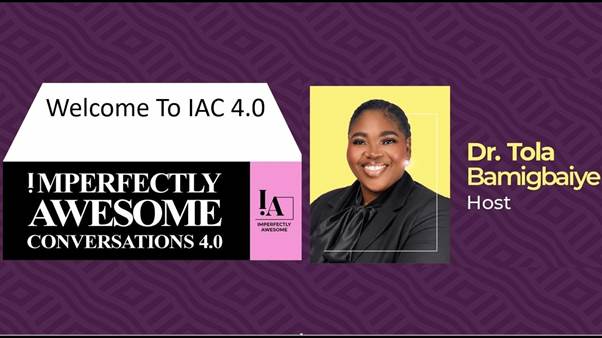
At the recently concluded Imperfectly Awesome Conversations (IAC) 4.0 in Lagos, convened by Dr. Omotola Bamigbaiye, a deceptively simple idea took centre stage: Enough. Not as resignation, but as power. Not as limitation, but as grounding.
In a world structured around excess – more growth, more productivity, more visibility – the assertion that one is already “enough” appears almost subversive. Yet this is precisely where the philosophical depth of the summit lies. Beneath its language of resilience and authenticity sits a rich intellectual lineage traceable to thinkers like Martin Heidegger, Edmund Husserl, and Søren Kierkegaard, whose ideas now find unexpected relevance in corporate boardrooms, entrepreneurial ecosystems, and brand strategy.
What emerged from the convergence in Lagos is not merely a motivational framework, but a philosophical reorientation of value itself – one that has profound implications for how individuals live, how leaders lead, and how brands connect.
From Existential Anxiety to Strategic Clarity
At the heart of Martin Heidegger’s philosophy is the concept of authentic existence. Human beings, he argued, often live in a state of distraction, absorbed in societal expectations and external validation. He called this condition “the they” – a world where identity is outsourced and meaning is diluted.
The modern workplace mirrors this condition almost perfectly. Metrics dominate meaning. Visibility often replaces value. Individuals perform roles rather than inhabit identities.
The IAC 4.0 emphasis on “being enough” directly disrupts this pattern. It calls individuals back from performative existence to grounded presence, where value is not externally assigned but internally recognised.
In practical terms, this has strategic implications. Leaders who operate from a place of internal sufficiency are less prone to reactive decision-making, less driven by fear-based competition, and more capable of long-term thinking. Organisations built around such leadership tend to demonstrate:
- Greater resilience under pressure
- Stronger cultural coherence
- More sustainable performance over time
Thus, what begins as existential philosophy translates into institutional advantage.
Husserl, Attention, and the Economy of Meaning
Edmund Husserl’s phenomenology centres on one critical idea: intentionality – the notion that consciousness is always directed toward something. In today’s digital economy, this insight becomes profoundly relevant.
We live in what can be described as an attention-saturated but meaning-deficient environment. Individuals are constantly engaged, yet rarely anchored. Brands capture attention, but often fail to convert it into trust or loyalty.
The “Enough” philosophy addresses this by restoring intentional engagement. It shifts focus from endless striving to meaningful participation.
This is where the connection to business becomes unmistakable.
Consider the recent campaign by NESCAFÉ, which positions itself as deeply aligned with the Nigerian ethos of hustle and resilience. Its “Next Level Promo” goes beyond transactional marketing by offering tools – laptops, cameras, vocational kits – that enable real economic participation.
On the surface, this is a consumer promotion. At a deeper level, it reflects a phenomenological alignment: the brand is not merely capturing attention; it is entering the lived experience of its audience.
This is Husserl in practice. Meaning emerges not from abstract messaging, but from how a brand situates itself within the everyday realities of its consumers.
Kierkegaard and the Courage to Be Imperfect
Søren Kierkegaard introduced the idea that authenticity requires a leap – an acceptance of uncertainty, vulnerability, and imperfection.
This insight sits at the core of the Imperfectly Awesome movement.
In corporate environments, perfectionism often masquerades as excellence. Yet it frequently produces the opposite: fear of failure, stagnation, and suppressed creativity.
By contrast, the IAC framework reframes imperfection as a condition for growth rather than a barrier to success.
This has direct implications for:
- Innovation ecosystems, where experimentation is critical
- Leadership cultures, where vulnerability fosters trust
- Talent development, where psychological safety drives performance
The most adaptive organisations today are not those that eliminate error, but those that learn rapidly from it. In this sense, Kierkegaard’s existential leap becomes a blueprint for innovation strategy.
Resilience as Lived Experience, Not Corporate Slogan
The presence of leaders such as Segun Ogunsanya and Mojisola Meranda at IAC 4.0 underscores a critical point: resilience is not an abstract virtue; it is a lived, institutional reality.
Too often, resilience is reduced to a corporate cliché – invoked in speeches but absent in systems.
What the summit achieves is a redefinition. Resilience is presented not as endurance alone, but as:
- The capacity to recalibrate under pressure
- The ability to remain authentic in complex environments
- The discipline to act despite uncertainty
This aligns closely with contemporary organisational theory, where resilience is increasingly viewed as a dynamic capability – a system’s ability to adapt, learn, and transform.
The Convergence: Philosophy, Markets, and Human Value
What connects IAC 4.0 and the NESCAFÉ campaign is not merely a shared vocabulary of resilience. It is a deeper convergence around human-centred value creation.
Both recognise a fundamental truth of the modern economy:
Growth is no longer driven solely by scale or efficiency. It is driven by meaning, identity, and participation.
- Individuals seek work that affirms their identity
- Consumers respond to brands that reflect their lived reality
- Societies reward systems that enable inclusion and dignity
The philosophy of “Enough” sits at the centre of this shift. It stabilises identity in a volatile world. It grounds ambition without extinguishing it. It enables individuals to act not from deficit, but from wholeness.
BrandiQ Insight: Why This Matters for Business and Leadership
For BrandiQ’s core audience – executives, investors, and institutional leaders – the implications are both immediate and strategic.
First, organisations that fail to integrate authenticity into their culture will struggle to retain talent in an era where meaning increasingly outweighs compensation.
Second, brands that do not align with the lived experiences of their consumers will capture attention but fail to build loyalty.
Third, leadership models built on control and perfection will underperform in environments that demand adaptability and innovation.
The emerging competitive advantage lies in philosophically grounded strategy– where organisations understand not just markets, but the human condition that shapes them.
Conclusion: Enough as a New Metric of Power
The most radical idea to emerge from IAC 4.0 is also the simplest: that enough is not the opposite of ambition; it is its foundation.
In philosophical terms, it restores authenticity.
In organisational terms, it builds resilience.
In market terms, it creates trust.
And in a world defined by noise, speed, and constant comparison, the ability to operate from a place of “enough” may well become the most powerful differentiator of all. What began as a conversation in Lagos is, in reality, part of a much larger shift – one in which philosophy is no longer confined to academia, but is actively reshaping how individuals live, how businesses compete, and how societies evolve.